

Welcome to Seomra Ranga, the Hub for Primary School Resources. For the overseas visitors “Seomra Ranga” means “classroom” in the Irish language.
Seomra Ranga has been successfully providing tried and tested resources for primary school classrooms since 2007. Since that time, the site has gradually built up a strong following amongst educators as a repository of quality teacher-created resources. The resources on the site, which support all areas of the curriculum, are arranged in accordance with the curricular provisions of the Irish primary school….
Trócaire Lenten Resources 2012
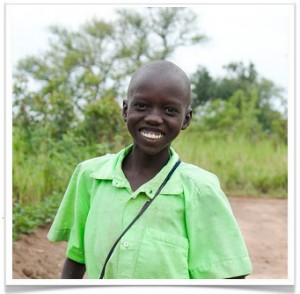
Photo courtesy Trócaire website
Next Wednesday, February 22nd marks the beginning of Lent 2012 and, as usual, the Trócaire charity has produced some great classroom resources to coincide with the season of Lent. Uganda is the focus of the resources this year and there are separate resources for Junior Primary pupils, Senior Primary pupils and Post-Primary pupils. The resources provide pupils with information, lessons, photos and activities that explore Trócaire’s work through the lens of Uganda. It considers the impact of a community dealing with difficulties facing them post conflict. read more…
Engineers Week

The Minister for Education and Skills, Ruairí Quinn T.D., has joined Engineers Ireland in encouraging students, schools and parents to get involved in Engineers Week 2012, which will be taking place across Ireland between the 27th February and 4th March 2012. The week-long series of activities across the country is run by Engineers Ireland and is a campaign held annually to promote engineering as a career and the importance of the profession to Ireland. The theme for Engineers Week 2012 is “Connecting Our Lives“. read more…
Animal Homes QR Codes
I’ve written previous blog posts about
Leabhair Labhartha
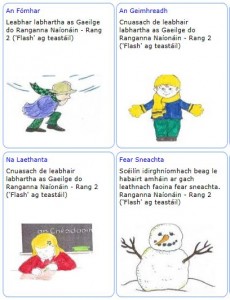
A nice new addition to the bank of resources on the Scoilnet website is a collection of short books “as Gaeilge”. They are aimed at younger pupils in the primary school, perhaps for pupils as far as Rang III. In terms of content and presentation, the books are basic enough, however they will be fine to assist pupils in practising their léitheoireacht Ghaeilge. The language used in the readers is also quite basic but that is suitable for many younger pupils. read more…
Signs of Spring 2012 Twitter Project Review
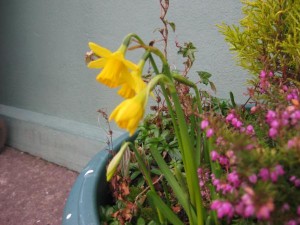
Photo courtesy Kilbarry NS
With the approach of the beginning of February and the beginning of Spring with the celebration of Lá Fhéile Bríde, I decided to organise a Twitter Project to gather information, observations and photographs on the signs of Spring 2012. Given that this was the first year that we tried this project, I think we can say that it was relatively successful. Lots of schools and teachers became involved and all used the hashtag #signsofspring2012 to keep all of the Tweets together. read more…
Blue Star Programme
 Last Tuesday, the Taoiseach, Enda Kenny TD and Minister of State for European Affairs, Lucinda Creighton TD launched a new pilot programme for primary schools which focuses on the EU, called the Blue Star Programme. The idea of the Programme is to foster better understanding and knowledge of the European Union and how it affects our lives amongst Irish primary pupils through classroom projects and activities. The Blue Star Programme will introduce participants – pupils, teachers, parents and the wider community to the EU, what it means and how it works. read more…
Snuggle Mountain
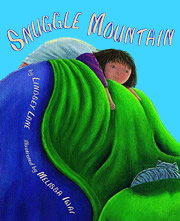 Snuggle Mountain is a beautiful story app in HD for iPad or iPhone/iPod for younger pupils. The story, written by Lindsey Lane, is centred around Emma, a little girl who must climb to the top of Snuggle Mountain to wake the two-headed Giant who is caught in a Sleeping Spell. She wants pancakes for breakfast and she must enter the cave at the top of the mountain to wake the Giant who has forgotten about breakfast. read more…
Draft School Self-Evaluation Guidelines
 The Inspectorate recently published “School Self-Evaluation: Draft Guidelines for Primary Schools“. The Guidelines are intended to support schools to engage in robust self-evaluation of teaching and learning. Its purpose is to allow schools to take the initiative in improving the quality of education provided to its pupils. The Guidelines also offer a framework for school self-evaluation that places the process in the context of school development planning and the school improvement plan. The Guidelines are intended to assist schools to: read more…