


Welcome to Seomra Ranga, the Hub for Primary School Resources. For the overseas visitors “Seomra Ranga” means “classroom” in the Irish language.
Seomra Ranga has been successfully providing tried and tested resources for primary school classrooms since 2007. Since that time, the site has gradually built up a strong following amongst educators as a repository of quality teacher-created resources. The resources on the site, which support all areas of the curriculum, are arranged in accordance with the curricular provisions of the Irish primary school….

Pelmanism 05
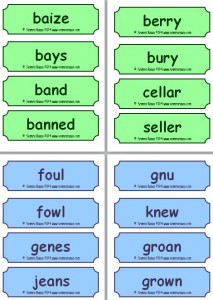 Pelmanism is the name of the memory game which you play by turning up pairs of cards from a pack and trying to pick out matching pairs. It is named after the Pelman Institute which was set up for the study of memory in London in the 1930s.
This oral language memory game focuses on homophones (words that sound the same but are spelled differently). There are three sets of sixteen cards (eight pairs) in this pack, 48 cards in all. The game can be played initially using one set and as the pupils become proficient, another set can be added.
Socks Number Strips
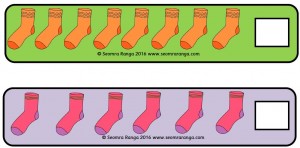 This resource is aimed at pupils in infants/first classes or SEN pupils. Its purpose is to assess the ability of the pupil to correctly count objects, in this case, socks. The focus is on numbers 6-15 so that the pupil has experience of bridging a ten when counting.
Laminate all of the pages in the resource. Cut out the ten number strips, the two blank answer strips and the yellow answer boxes.
Book Review: My Ireland Activity Book
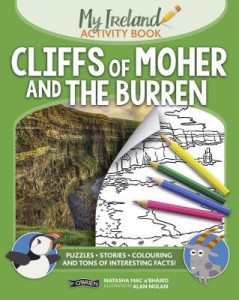 I loved this book. It has really fun activities and games in it. But my favourite pages are 12 + 13 (Where’s Larry) and my least favourite page is page 19/20 (postcard). I haven’t done much in it though and I don’t like the tricky things in it either. I would give this fun activity book 8/10. read more…
Comórtas “Saol Faoi Shráid”
 I previously wrote a blog post about “Saol Faoi Shráid” an animated children’s TV series created by Meangadh Fibín for TG4. The series is aimed at 3-6 year olds and follows the adventures of brother and sister duo, Glibín & Ribín, aliens from the centre of the earth.
A book based on the same series, “Saol Faoi Shráid – An Giotar Nua”, was launched at the Baboró International Arts Festival for Children in Galway last October. The book can be bought in a small and larger format read more…
Book Review: Rugby Flyer
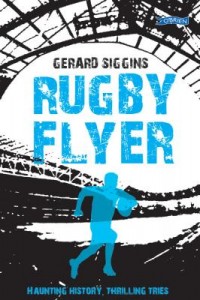 This is the fourth book in the series. If you’ve read ‘Rugby Spirit’, ‘Rugby Warrior’ or ‘Rugby Rebel’ then I’m sure you will love this book as well. But rest assured you do not need to read the others to enjoy Rugby Flyer. Rugby Flyer is a book all about rugby.
In this series, this was the first one I read. If you don’t know the basics of rugby but still want to read it (like me) then I think you would still love it as I did. It’s just that in the match you might not understand what’s happening at all. This book isn’t about the matches but more about rivalry, characters, ghosts and Irish history. read more…
Cupcake Number Strips
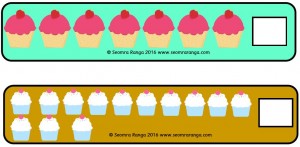 This resource is aimed at pupils in infants/first classes or SEN pupils. Its purpose is to assess the ability of the pupil to correctly count objects, in this case, cupcakes. The focus is on numbers 6-15 so that the pupil has experience of bridging a ten when counting.
Laminate all of the pages in the resource. Cut out the ten number strips, the two blank answer strips and the yellow answer boxes. Place velcro in each of the answers boxes on the right of each number strip
Pizza Vocabulary Matching
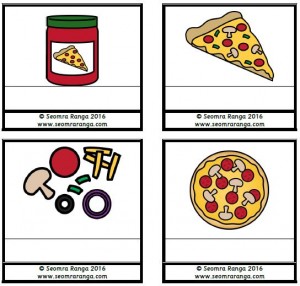 This resource is aimed at pupils in junior classes or SEN pupils with speech and language difficulties. It assumes an ability to read. The pizza vocabulary would also need to be taught in advance. Its aim is to assess whether pupils can match the pizza-related words with the appropriate images.
Laminate all of the pages in the resource. Cut up the images into 12 separate cards. Cut up the pizza vocabulary on page 3.
Station Signs
 Lots of schools have recently been adopting Station Teaching as a methodology for the teaching of either literacy or numeracy. An example of types of stations for literacy stations in a classroom would be: spelling station; phonics station; creative writing station; grammar station; word puzzles station; reading station.