

Seomra Ranga Goes Spanish

Seomra Ranga has branched out and has provided new resources in Spanish for schools involved in the teaching of Spanish at primary level. Initially, resources provided for download include Días de la Semana (Days of the Week), Los meses del ano (The Months of the Year), Las Estaciones (The Seasons), Numeros (Numbers). It is hoped to develop the amount of Spanish resources available over the coming months. Special thanks in this regard go to Erin Ní Riain, firstly for suggesting the idea of Spanish resources, and secondly for kindly doing all the translation work. The resources can be downloaded freely.

Website

Seomra Ranga reached another milestone yesterday as the number of visitors to the site reached the 100,000 mark. The site has been online since September 2007 and the amount of free classroom resources on the site has been steadily growing. So too has the number of visitors to the site been steadily growing, especially over the last few months. As the site celebrated its first birthday in September 2008, it also had the highest monthly visitors since the site started. However this figure was surpassed in October 2008 when there were more than 22,000 visitors to the site, literally from all over the world. And it looks like this figure will again be surpassed for the month of November, during which the number of visitors reached the 100,000 mark. As the number of free resources on the site continues to grow, hopefully the number of visitors to the site will also continue to grow.
Best regards to all the visitors to the site. I hope that you find the Seomra Ranga resources suitable and practical for the classroom. As always, I’d like to appeal to more of the site visitors to search through your desktop and to share any of your own resources with the rest of the teaching community on the Seomra Ranga website.

New Christmas Website

A new Seomra Ranga website has just been launched. The Christmas @ Seomra Ranga website is dedicated to Christmas resources for use in the primary school classroom. Among the many resources contained on the site are:
-
Christmas posters and signs
-
Seasonal flashcards with Christmas vocabulary in English and Gaeilge
-
Cártaí Lúibe (Loop Cards)
-
Visual Arts lessons
-
Religious resources
-
Tin whistle notes for seasonal tunes
-
Booklets of Christmas carols
-
Christmas Quizzes
-
Vocabulary Word Walls
All of these resources can be downloaded for free from the website. As always, I would appreciate it that if you download a resource from the site that you upload another in return so that the bank of resources van be expanded. Visit the site at:

Gaeilge Resources

Scríobh Leabhar 2008

Fuair gach bunscoil sa tír an CD seo le déanaí. CD le haghaidh ríomhaire é atá lán le leabhair Ghaeilge scíobhtha ag daltaí bunscoile ó Ranganna Naíonáin go Rang VI. Is féidir na leabhair atá ar an CD a chur ar do chruadhiosca agus dá bhrí sin beidh gach rang sa scoil ábalta féachaint ar na leabhair. Tá an CD an-úsáideach má tá CBI (clár bhána idirghníomhaíochta) agat chun na leabhair a léamh leis na daltaí agus chun iad a spreagadh chun a leabhair féin a chruthú.
Is áis sár-mhaith é an CD seo. Léiríonn sé gur féidir le daltaí bunscoile, fiú daltaí sna ranganna naíonáin, an Ghaeilge a úsáid i mbealach taitneamhnach, suimiúil agus spreagúil. Is féidir le múinteoirí na leabhair ar an CD a úsáid mar áis teagaisc mar is iad na téamaí atá in a lán leabhair, na téamaí céanna atá luaite sa churaclam. Mar sin, má tá an múinteoir ag déanamh obair faoin téama “Bia”, is féidir féachaint ar an CD chun leabhair faoi bhia a fháil. Beidh na daltaí ag léamh faoin téama bia agus ansin, diaidh ar ndiaidh, beidh siad spreagtha chun a leabhair féin a chruthú.
Cé nach bhfaca tú an CD sa scoil, cuir ceist ar an príomhoide chun a fháil amach an bhfuair an scoil cóip. Tá tuile eolais le fáil ón gréasán don Chomhairle um Oideachas Gaeltachta & Gaelscolaíochta. Tá cuid de na leabhair le feiceáil ansin freisin:

Hallowe’en Resources
Hallowe’en is almost here and teachers are at the moment doing classroom planning with a view towards using the season of Hallowe’en in teaching different areas across the curriculum. Seomra Ranga has a dedicated section of classroom resources with a Hallowe’en theme. Some of the latest Hallowe’en resources added to the site include a Rockets language poster; a Make a Potion poster with language to help when creating a witch’s potion; a poster to help pupils to describe a witch in creative writing; a Spooky Sounds poster using the theme of hallowe’en to teach the silent letters k and b; a set of colourful Hallowe’en posters; a set of colourful Oíche Shamhna posters; a set of flashcards with Hallowe’en vocabulary; Hallowe’en Classroom door signs. There’s plenty more Hallowe’en classroom resources. You can download them all freely.

Logainmneacha na hÉireann
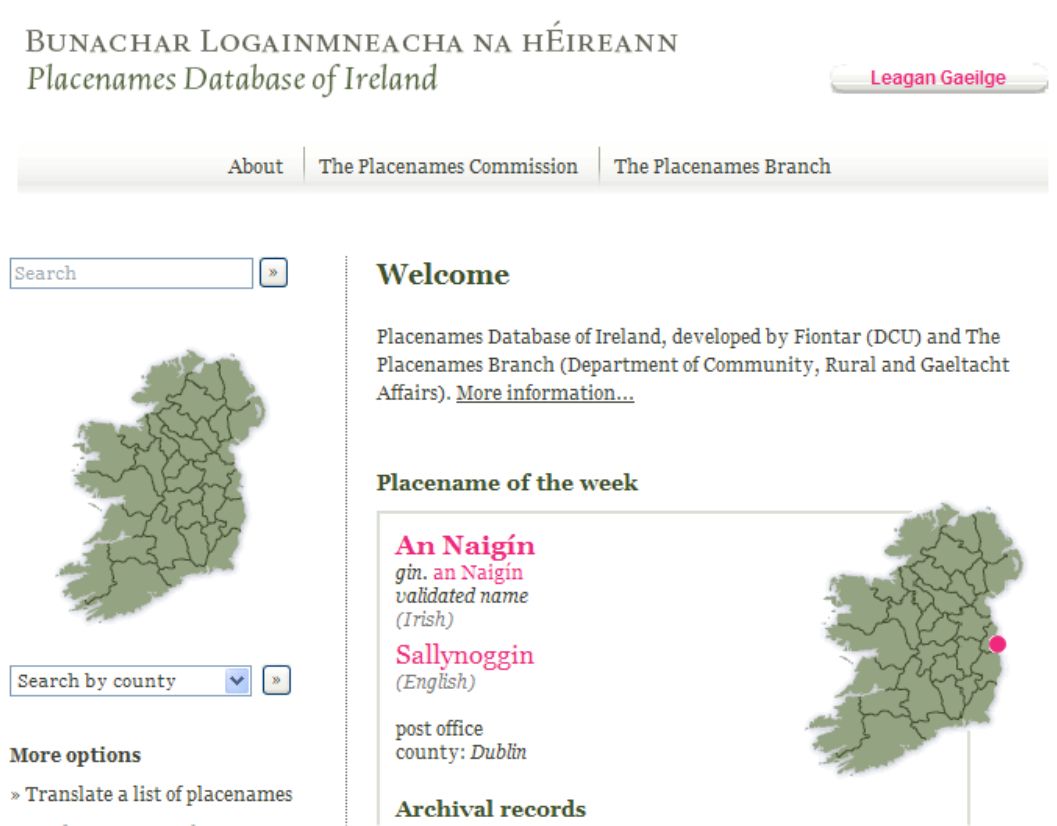
Logainm is a new website containing a database of the placenames of Ireland. The site comes in an English version or a Gaeilge version and you can switch between both quite easily. The purpose of the site is to make available to the public Irish place names that have been officially approved by the Placenames Branch, and these names can be searched either through Irish or through English. If you simply want the correct translation for a particular placename, you can do a search on the homepage. If there is more than one place with the same name, you will be given all the possibilities and you can select which one applies to you.
If you want to do some research about the placenames in your locality, you can either click your county on the map on the homepage or you can use the dropdown box, also on the homepage. When you get to your county you have the option of finding out about the county under any of the following headings: baronies, electoral districts, parishes, townlands, rivers, bays, hills, promontories, bridges, waterfalls, features, population centres, lakes, islands and archipelagos, post offices, monuments, mountains/mountain ranges, streets, strands. If, for example, you wish to search about the parish in which your school is located, you click parishes and then click your local parish. You may then wish to find out about the townlands in the parish so you can click townlands. You can then click on any of the individual townlands in your locality. You will then be given the name of the townland, the name in Irish (if it has been officially verified), the hierarchy of the townland (i.e. the county, the barony, the parish, the townland). If there are any archival records pertaining to the name of the place they can also be viewed. These are scans of original documents citing the names of the place. In the cases of counties Waterford, Galway and Donegal, sound recordings of some of the placenames are available in both Irish and English and these give the official pronunciations. It is intended that in the future sound recordings will be made of all the other counties on a phased basis over the coming years.
This website should prove to be an invaluable resource to schools and teachers. The site will be an excellent reference point when researching local history. The site is really easy to use, well laid out and should be a site to be bookmarked to dip in and out of again and again. The site can be accessed at:

Seomra Ranga’s First Birthday
The Seomra Ranga website is one year old and it’s been a busy year. The number of visitors to the site has been steadily growing throughout the year to a total of almost 67,000 unique visits during the past twelve months. This month alone (September) has been the busiest month so far with visitors totalling 12,000. This is more than double the number of visitors for the first month of the website last year.
I’m constantly trying to develop and provide new resources for the site. However, during the second year of the site, I’d really like to see more resources and lesson plans being shared by more of the visitors to the site. So if you’ve benefited by downloading a resource from the site, perhaps you could consider uploading a new resource in return. Here’s to the development of the site during the next twelve months!

Signs and Posters
 A selection of new posters and signs for the classroom has now been uploaded onto the Seomra Ranga website. There is a series of posters on “Mothúcháin”; a series of posters on Music Notation to help pupils learn the main symbols of music notation; a series of posters on “Ainmhithe sa Zú” with illustrations and captions as Gaeilge; a series of Sports posters as Gaeilge with each poster bearing the phrase “Bain taitneamh as ……”; a series of posters on “Uimhreacha 1 – 10”; a series of labels for “Postanna sa Sheomra Ranga” – jobs that might be allocated to pupils in the classroom; a series of flascards with the names of the Gifts of the Holy Spirit for the teaching of Confirmation; a series of flashcards with the names of the Fruits of the Holy Spirit for the teaching of Confirmation; a series of posters of dathanna as Gaeilge; a series of flashcards with foclóir le haghaidh Cluiche Boird – phrases to teach the pupils when playing a board game as Gaeilge; a series of posters of fractions – halves, quarters and eighths. All the posters are in .pdf format and should be relatively easy to download and print. Please let me know if there are any errors or omissions and they can be rectified immediately. If anyone has suggestions of posters, signs or labels that they think may be useful in the Seomra Ranga please let me know at info@seomraranga.com

Moneyville
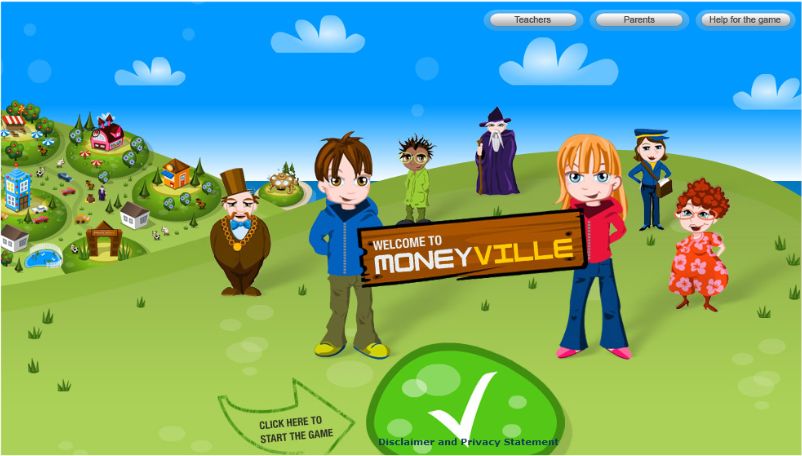
Moneyville is a new Irish website with the aim of teaching younger children more about money, the value of money and saving money. This is a flash-based site which is very colourful with a high standard of animation. It should be instantly attractive to young children. The introduction to the adventure is explained by the Mayor of this fictional town called Moneyville. The central character in the adventure appears when you first enter a username and password. You can change the look of the central character by changing his clothes, hairstyle etc. There is a lot of speech on the website with characters giving you instructions. You can choose to have this text also on the screen. This may be helpful to pupils with hearing difficulties.
When you enter the town of Moneyville, you can visit the Post Office, the Apple Stall or the Time Machine. In each place you visit, you can work to earn some money. In Moneyville you can earn silver and gold coins. One gold coin is worth ten silver coins. At any time you wish, you may visit Pennies shop and spend some of the money that you have earned. The idea that the site is trying to get across to children is that you have to work hard to earn some money and that there may be some things in the shop that you cannot afford. If this is the case and you really want the item, you can save your money until you have enough to buy the item. The pupil can place some desirable items in the Wish Jar until they have saved up enough money to buy them.
In the Post Office the pupil has to help out with the deliveries by sorting out the most expensive items from the less expensive items. This encourages children to understand the value of certain items. By helping in the Post Office, the pupil can earn some money. At the Apple Stall, the pupil has to catch apples falling from the apple tree before they hit the ground. This helps with keyboard skills and money can be earned by doing this work. When the pupil visits the Time Machine they can go on their travels. However, they need to have already earned some money as it costs one gold coin to go on a trip. The trips can take the pupil back to the time of the dinosaurs, back to Ancient Egypt, back to Ancient Rome or back to the Middle Ages. In each place they have fun things to do.
When pupils have done lots of the games and adventures on the site they can visit the Sorcerer who knows where there is treasure hidden in Moneyville. To get the Sorcerer to reveal the whereabouts of the hidden treasure, the pupil has to answer questions about money which they will have learned by visiting different areas of the site. If they can answer the questions correctly, they can find the hidden treasure and spend the money in the shop.
This website is set up by National Irish Bank which obviously has an interest in encouraging the customers of the future to save money and spend wisely. However, this is a very worthwhile website and is a positive addition to the resource bank of the primary school teacher. The site is mainly aimed at pupils in first and second classes. In the teacher section of the site are a number of worksheets that the teacher can use when teaching money in maths. The worksheets, in .pdf format, are colourful, attractive and build on the ideas of the website: cheap and expensive, saving money, how much money do I need, spending money wisely etc.
The site is well worth a visit. It can be found at: http://www.moneyville.ie/