


Welcome to Seomra Ranga, the Hub for Primary School Resources. For the overseas visitors “Seomra Ranga” means “classroom” in the Irish language.
Seomra Ranga has been successfully providing tried and tested resources for primary school classrooms since 2007. Since that time, the site has gradually built up a strong following amongst educators as a repository of quality teacher-created resources. The resources on the site, which support all areas of the curriculum, are arranged in accordance with the curricular provisions of the Irish primary school….

Shamrock Numbers
Seasonal posters with a shamrock border, featuring the numbers 1 – 20. (.pdf file 438KB) Download File…
St. Patrick’s Day Bookmark 01
Seasonal printable bookmarks with the caption, “St. Patrick’s Day”. Bookmarks are a good incentive for reading for pleasure. (.pdf file 7.95KB) Download File…
Phonics Poster – ar Words 03
Phonics poster showing examples of words with the -ar pattern. (.pdf file 77.9KB) Download File…
Lenten Resources 2011
The religious season of Lent is about to begin next week, beginning with Ash Wednesday on March 9th. The Irish website Kandle has put together some resources to help the primary school teacher prepare the pupils during the season of Lent. For anyone not familiar with the Kandle website, it is the website of the Kildare and Leighlin Diocese which has been making religious classroom resources available to teachers for quite some time. These resources, especially those for Advent and Lent, are usually practical and are most suitable for use in the classroom.
Lenten Resources for 2011 are now available to download freely on the Kandle website. The 36 page Lenten pack contains resources for Ash Wednesday; a prayer service for Ash Wednesday; Wordsearches; Colouring Pages; Activities for each of the Sundays of Lent; Information on Feasts and Saints days that occur during Lent; Stories from the Bible; Mothers’ Day; Explanations and Activities for Holy Week; a Quiz; May the Month of Mary.
This Lenten Resource Pack is now available to download (.pdf file 3.93MB).
Interview With Sheila Nunan, INTO – Call for Questions
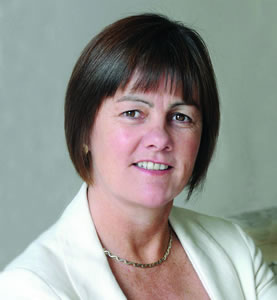
A new addition to the new website commenced in January when a series of monthly interviews kicked off with an interview with Áine Lawlor, Director of the Teaching Council. This was followed up with interviews with Education Spokespersons from some of the main Political Parties prior to the General Election. Seomra Ranga is now delighted to announce that Sheila Nunan, General Secretary of the INTO has accepted an invitation to be the next subject for our interview series.
Sheila Nunan is General Secretary of the Irish National Teachers’ Organisation (INTO), the first female to date in its 141-year history to lead the INTO. She has been a member of the Central Executive Committee (CEC) of the INTO since 1995 and was INTO President in 2005/2006. In 2006 Sheila was elected Deputy General Secretary/General Treasurer and served in that role until her election as General Secretary in 2009, securing more than 60% of the ballots cast by the membership. Sheila is a former primary school teacher and principal. She taught in Tallaght and in Bray. She is a graduate of University College, Dublin and St. Patrick’s College, Drumcondra.
This is where visitors to the website can become involved. Sheila has agreed to take questions from visitors to the website. You can submit questions for Sheila via the Facebook or Twitter pages, or by posting a comment on this post. These questions must not be of a specific nature but about points in general in relation to education in Ireland and the work of the INTO. Questions should also not be of a personal nature and should be succinct and to the point. I will collate / edit /amalgamate these and submit them to Sheila for answers / comments. I will then put Sheila’s answers together into a post on the Seomra Ranga website.
This is a great opportunity for practising teachers to put questions directly to the General Secretary of the INTO, so I hope that we can get a series of questions from a cross-section of the teaching community. I wish to express my appreciation to Sheila Nunan for agreeing to submit herself to questioning through the Seomra Ranga website. If there are other figures involved in education that you think would be a good interviewee, please let me know.
The Story of St. Patrick
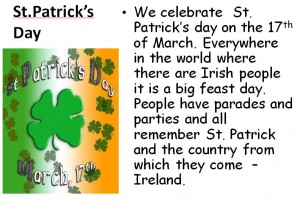
Short Powerpoint presentation telling the story of St. Patrick from his boyhood to his return to Ireland to tell the pagan people about God.
Source: Shaygirl
(.ppt file 473KB) read more…
Census Charlie Resources
Census Background
The 2011 Census will take place on Sunday April 10th next, when every household in the country will complete their Census form. The census is a count of the population of the country. It also asks questions relating to every person in the country on Census night to collect information on a variety of important topics including age, education, language spoken, employment, health etc. The information provided is strictly confidential and only statistical reports are published. The Central Statistics Office (CSO) conducts a census of Ireland every 5 years. It employs a temporary field force of nearly 5,500 to carry out the census across the country, including almost 5,000 census enumerators who will deliver and collect census forms to every household.
A Census is conducted to give a comprehensive picture of the social and living conditions of our people in 2011. Only a Census can provide such detail. The results are essential tools for effective policy, planning and decision-making. An accurate census is in everyone’s interests. It provides the knowledge so that public resources can be shared evenly across the country and to ensure that services at local level are relevant to all the people who live there. Census figures are important to each and every community in Ireland because they provide information about the population down to the local level across a range of different criteria e.g. age, education, employment, language spoken, health, etc. This information can be used to tell at a community, regional and national level about the composition of the population and to identify the needs and requirements of each group in planning for the provision of services. And the beauty of the census information is that everyone can use it – it’s free, it’s easy to access and it’s extremely useful.
Census History
Ireland has been conducting Censuses of Population since 1821. This enables us to track developments over a long period of time with considerable accuracy. The census is therefore a fundamental part of our national heritage and our collective knowledge about the Irish people. Unfortunately, most of the census returns prior to 1901 have been lost, either deliberately destroyed (1861 and 1871 returns), pulped because of paper shortages during World War 1 (1881 and 1891 returns) or destroyed when the Customs House was burned in 1922 (1821, 1831, 1841 and 1851 returns). Of the pre-Independence Censuses, only the 1901 and 1911 Census returns remain intact today. The publication of these records online at the National Archives has provided millions of Irish people and their descendants all over the world with the opportunity to discover their ancestors. This has been an extremely popular facility, with millions of visitors to the site since the 1901 records were first published in 2008.
Census Resources for Primary Schools
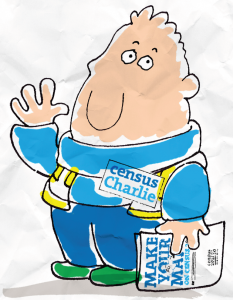
A set of topic-based lessons featuring Census Charlie has been developed to help primary school children understand what the census is about and to learn how and why a census is conducted. These have been developed and piloted by primary teachers for use in classes from first to sixth class. The aim of these lessons is to enable children to understand the census process and to teach skills in the collection, representation and interpretation of data. Census Charlie has lots of activities to make the learning fun. There are four lessons for each class grouping: 1st/2nd, 3rd/4th, 5th/6th. Each lesson has been developed specifically to incorporate the principles of the Primary School Curriculum and content objectives for each lesson are provided. The lessons have obvious connections to the English curriculum (Language development), Maths (Number and Data strands), SPHE (Myself and the Wider World Strand), SESE History (Continuity and Change Over Time strand – comparing past censuses), SESE Geography (Human Environments strand).
Census Lesson Packs include:
• Comprehensive teacher notes and lesson plans
• Census information and key messages
• The Census Story
• Census flashcard/fact cards
• Sample Classroom Census forms
• Graph templates and tally sheets
• ICT tasks
• Integration and linkage ideas
• Assessment tasks
• Home/school links
• Extension activities
All of these classroom resources can be downloaded from the Census Website Schools’ Resources page.
St. Patrick’s Day Scoilnet Themepage
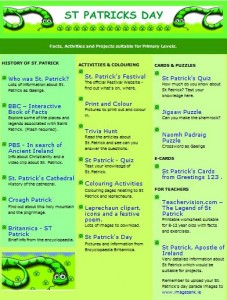 For those who may not be aware, Scoilnet has put together forty-four different Themepages covering a broad range of themes across all areas of the curriculum including World War II, Weather, Safety, Water, Shapes All Around Us, Roald Dahl and many others.
They also have a dedicated Themepage for St. Patrick’s Day which teachers should visit at this time of the year. It has seasonal ideas for projects and activities for the classroom on the theme of St. Patrick, his life and his legacy. It provides links to other sites with information on the life of St. Patrick, activities, colouring pages, quizzes, cards and puzzles.