
Bookmark 05
Printable bookmarks with the motto “Read a Good Book”. Bookmarks are a good incentive for reading for pleasure. (.pdf file 139KB) Download File…

Questions for the Education Spokespersons
With the date of the impending General Election looming ever closer, we need to know what the plans of each of the political parties are in relation to education, teaching and the role of technology in schools. So, with this in mind, I plan to send a list of questions to each of the Education Spokespersons: Mary Coughlan (Fianna Fáil), Fergus O’ Dowd (Fine Gael), Ruairí Quinn (Labour), Paul Gogarty (Green Party) and Pearse Doherty (Sinn Féin). The answers to these questions will be posted on this site so that teachers may be better informed about the education policies of each of the parties.
I’m asking visitors to the site to suggest questions that can be asked to each of the spokespersons. I think 8 – 10 questions will suffice. The questions should be short and succinct and, in the interests of equity and fairness, the questions should be suitable to be put to each of the parties so that readers can compare and contrast the answers. The objective of this exercise will not be to vent anger at the Government parties. We need to know what the plans of each party are for the future of education.
So, if you think you have a short question that could be asked of each of the political parties, please add it as a comment at the end of this post, or add it to the Seomra Ranga Facebook page. We need to get organised fairly quickly, so questions need to be in by next Monday Jaunary 31st.
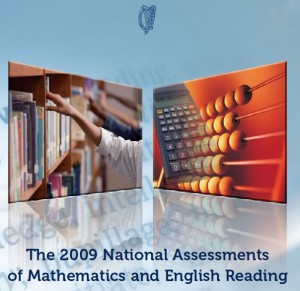
The 2009 National Assessments of Mathematics and English Reading
Back in November, the Educational Research Centre published “The 2009 National Assessments of Mathematics and English Reading“. National Assessments take place every five years, with almost 8,000 pupils taking part in the most recent survey. The study is one of the largest studies of primary school pupils in this country. The 2009 study was the first time the same pupils completed both the maths and the reading components. The report examines the factors that relate to performance on reading and maths. Dr Seán Close, one of the authors, commented, “We were surprised to find no gender differences on overall maths scores at either grade level, and none on the Sixth class reading test either. However, the results for reading at Second class were as you might expect – girls outperforming boys.”
Many factors related to performance were common to reading and maths. For example, pupils who had lots of books and other educational resources in their homes, who were from small families, or high SES (Socio-Economic Status) families tended to perform best on both tests. For immigrant children, language spoken at home was more important than place of birth. Author Dr Eemer Eivers cautioned that “Most “newcomer” pupils spoke English at home, and their test scores were not that different to native-born pupils. It was the much smaller group of pupils who didn’t speak any English at home who did particularly poorly on the reading test, but only slightly below average on maths.”
Pupil family background factors were among those most strongly related to test scores. One of the authors, Dr Gerry Shiel explained “The study shows the vital role that parents have in promoting reading and maths skills. Parents are the first educators of their children. It’s important to emphasize to parents that simple things –buying books for your pre-school child or counting aloud the number of items in your supermarket trolley – done on a regular basis, can have great benefits.”
Other characteristics related to higher test scores included (for schools) high attendance rates and a high SES enrolment, and (for teachers) teaching experience, additional qualifications, and limited use of workbooks and worksheets in class. Although large class sizes were raised as an issue by teachers and principals, the study found no significant effects on test performance.
Since the last National Assessments in 2004 there have been large increases in the percentages of pupils born outside of Ireland, from lone-parent families, and with a quiet place to study at home. Dr Eivers noted that “We have seen dramatic increases in home internet access, but no change in the number of books in the average home. This has consistently proven to be one of the best predictors of how pupils will perform on reading and maths tests. Yet, about one in ten pupils still has fewer than 11 books at home, suggesting that the message is not getting through to some parents.”
The authors suggest a closer examination of teacher professional development is needed, to ensure that the core areas of literacy and numeracy receive adequate coverage. They suggest that schools make greater use of standardised test results, and propose improvements in the feedback provided to parents and in the provision of additional support to pupils. The report also identifies mathematical problem-solving and dealing with measures as particular weaknesses for pupils and contradicts the view that calculator usage is detrimental to the development of mathematical skills. “There is a common misconception that calculators shouldn’t be used in primary school. In fact, correctly used, they can enhance pupils’ ability to deal with complex mathematical concepts” said Dr Close. For reading, the report recommends more attention be directed at developing pupils’ higher-order comprehension skills and ability to explain their thinking.
The 2009 National Assessments of Mathematics and English Reading is published by the Educational Research Centre (ERC), and can be downloaded or purchased for €12 from the ERC website.
For further information on the National Assessment 2009, including examples of test questions and questionnaires is available HERE
Elections Wordle
Word cloud created using the website www.wordle.net This can be used as a handout to introduce pupils to the language of elections, democracy and the electoral process. View Wordle…
Ceisteanna Toghcháin
Luaschártaí le ceisteanna toghcháin a bheadh á plé ag am toghcháin. (comhad .pdf 33.6KB) Íoslódáil an Comhad…
Páirtithe Polaitíochta
Luaschártaí le hainmneacha na bPáirtithe Polaitíochta in Éirinn. (comhad .pdf 11.4KB) Íoslódáil an Comhad…
Election Vocabulary
Flashcards with all the vocabulary pertaining to the electoral process – includes words such as democracy, candidate, polling station, quota, mandate, electorate etc. (.pdf file 320KB) Download File…
Election Issues
Flashcards with vocabulary for possible issues pertaining to any election. (.pdf file 47.2KB) Download File…
Make A Martian
Around Hallowe’en I became aware of an iPod app through Twitter (through Mary Farmer who will be attending this year’s CESI National Conference) called Make a Martian. It’s a really simple app to use and the pupils loved it. They quickly discovered how to use the app themselves. You are given a basic background and…

CESI Conference Programme 2011
The Computer in Education Society of Ireland (CESI) will hold its annual conference entitled “ICT in Education – Changing Landscapes” in Portlaoise Heritage Hotel, 4 Feb, 7 – 9 PM and Portlaoise College, 5 Feb, 9 AM – 4.30 PM. Registration for the Conference is now open and you can register for either or both the Friday night programme and the Saturday conference/workshops. The Conference Programme has just been released and the highlights include:
1. Tom Barrett to Keynote Conference 2011
Tom is the Deputy Head Teacher at John Davies Primary School and is passionate about E-Learning and the role technology can play in support of good teaching and learning. He is a leading practitioner in multi-touch technology and it use in the primary classroom, online learning tools, implementation across a broad curriculum, use of IWB to support teaching and learning, Games Based Learning, emerging technologies, the role of social media in education and above all engaging kids with the right technology tools to support their learning. All in all, seeing and exploring the untrodden path. More on Tom here http://flavors.me/tombarrett
2. Ciaran McCormack & Chris Miller giving the Apple Experience
Ciaran and Chris will be leading two workshops that explore a variety of the tools that have made Apple such an attractive and popular platform for education. The workshops will be repeated morning and afternoon to give you the chance to attend both workshops. Ciaran will show you how to create your own interactive ebooks with text, video and audio that you can view on any mobile device and what’s more, anybody will be able to achieve this if they understand the basics of Microsoft word. Chris will help you to create simple manageable 40 min lessons where the children will create weather reports,where they can appear anywhere in the world,or field reports for geography or science experiments using simple green screen techniques that is achievable by all. For a full list of the areas these workshops will cover check out the conference programme here http://cesi.ie/conference-2011-programme
3. The Google Apps Experience
Whether you are still considering if Google Apps would be a good solution for your school or have already made the jump and want to know more this years conference will have you covered. We will be coming at the Google Apps experience from three different angles and again we have organised the timetable so that you can attend all three and go away at the end of the day with an in depth understanding of what Google Apps for Education can offer you, your students and your colleagues. Brian Daly of Adamstown Community College relates his schools story and will explore the reality behind the setting up, rollout and uses of Google Apps. Kenneth McLeod will deal with the more technical aspects of rolling out Google Apps and aims to help people with a small level of technical ability to have the confidence to set up Google Apps Education Edition. John Dalton, Ross Mahon & Steven Daly will run workshops in the morning and afternoon that will give you hands on experience and a chance to explore the ttols that make up the Google Apps suite.
4. Scratch Meets Microsoft Kinect – Stephen Howell
Stephen Howell has hit the headlines recently for his use of the Kinect add-on for XBox 360 with a PC to record actor movements and then play them back using Scratch. This allows students to act out scenes or role play and then play them back with different avatars in Scratch. We are excited that Stephen is bringing this breakthrough technology to this years conference. A basic knowledge of Scratch is helpful but not essential, as an introduction to Scratch will be provided. Check out this video to get an idea of what can be done with the skills taught in this workshop http://vimeo.com/18562642
5. Using the iPod Touch in the Primary School Classroom
Damien Quinn will lead a very hands-on workshop. There will be an explanation of the set-up for the use of the iPod Touch in the classroom. A group of 3rd class pupils will demonstrate how they use the iPods as an educational tool as well as demonstrating a number of apps that are used for different curricular areas. Participants will be free to mingle with the pupils to see the iPods in operation. There will be some extra iPods for participants to use during the workshop. There will also be a chance for participants to ask questions about integrating this technology in the classroom.
6. Geomodelling with Google Sketchup
Paul Lee and Alan O’Brien will lead this workshop where you can learn the basics of Google Sketchup and how it can be used to build 3D models of landmarks in your locality. You will learn about a project they are pioneering to bring models of buildings around Ireland to Google Earth. How about getting your student to build a 3d model of your schoolfor inclusion in Google Earth – learn how
You can register for the Conference online at http://www.cesi.ie/conference-2011. Registration for the CESI Meet event on Friday 4th will be limited to 80 due to the size of the venue so register early to avoid disappointment. Registration for Saturday 5th won’t be capped but early registration will help with the organisation end of things. Don’t forget if you pay online with your credit card or via a PayPal account you will get a discount. Details are on the website.
You can follow CESI on Twitter at @cesitweets to keep up-to-date on all things CESI, and use the hashtag of #CESI2011 for specific information on this year’s conference, including real-time tweets from attendees and participants on Friday evening and Saturday.