
Old School Reports
I recently found these in some old roll books in school, some dating back to the 1870’s. I’m not sure, but I’m presuming that they are old-style school reports. They appear to be for pupils in 5th and 6th class. Again, I’m not sure when exactly they were used. However, it’s safe to say that…

Tom Barrett’s Interesting Ways Series
For those of you who were at the CESI conference in Portlaoise in February, you will remember Tom Barrett who gave the keynote address on the Saturday morning. He spoke broadly about the idea of crowdsourcing content with teachers and asked each teacher to use a Post-It note they had been given to write one idea, one simple bit of advice or tip that could be shared. It could be about technology, after all it was a technology conference, but could have been about anything. Tom took these ideas home to England and put them together as a Google Doc to share with the world.
However, Tom also has a great series running on his website, EDTE.CH, called the “Interesting Ways” series. In this series he has asked other teachers to work collaboratively to share the wisdom of their collective classroom practices. This method of sharing is called “crowdsourcing” where he asks teachers to share ideas, or “interesting ways”, of approaching a topic or methodology in the classroom. Among the Interesting Ways on his website are:
- Use Google Forms in the Classroom
- Use Google Docs in the classroom
- Use the iPad in the Classroom
- Use the iPod in the Classroom
- Use the IWB in the Classroom
- Use Mobile Phones in the Classroom
- Use a Vizualiser in the Classroom
- Use QR Codes in the Classroom
- Get To Know Your New Class
- Support Writing in the Classroom
- Support Spelling in the Classroom
- Teach Reading Comprehension in the Classroom
- Use Nintendo DS in the Classroom
- Use Nintendo Wii in the Classroom
- Use Twitter in the Classroom
- Use a Wiki in the Classroom & many more
These ideas are all put together in shared Google Docs and are available to peruse or to add to. They are a rich source of knowledge and ideas and are well put together by classroom practitioners. Because mainly teachers have added the ideas, they are generally “tried and tested” in the classroom, so you know that they are ideas that work. They are well worth a visit, then bookmarking and then adding your own idea. All these resources can be viewed on Tom’s blog at http://edte.ch/blog/interesting-ways
Operation Godwit
I must admit that I’d never heard of a Godwit before, so when I received an email from Willie McSweeney from Scoil Iosaef Naofa, an all boys’ school in Cobh, Co. Cork, my first reaction was that this was yet another spam email amongst the hundreds of other that I get through the website. And when…
Division Tables Test
Division tables test containing 120 division tables including all combinations from ÷0 to ÷10, jumbled up on one A4 sheet. (.pdf file 15.5KB) Download File…
Mr Thorne Does Phonics
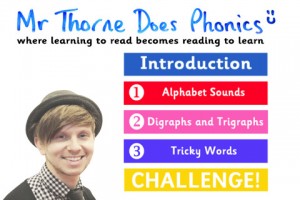
Mr. Thorne Does Phonics is a website of phonics resources for junior classes in the primary school. What is unusual about these resources, however, is that they are all made up of videos. The website is the creation of Christopher Thorne, a primary school teacher teaching in London. The website has been going for four years (about the same as Seomra Ranga!) and has grown in popularity since then. The website has also gained quite a bit of media attention in the UK as schools are finding that it lives up to its motto: “Mr. Thorne Does Phonics – Where Learning to Read Becomes Reading to Learn”.
The website takes a very progressive approach to the teaching of phonics for word attack and reading. There is a natural progression as you move from Phase 1 (Introduction) videos through to Phase 6. There is even a video in the Introduction section for use at parent induction evenings to instruct them as to how phonics is taught. There seems to be a video for almost every conceivable phoneme, consonant blend, vowel diagraphs, short and long vowel sounds. In Phase 6, there are videos focussing on spelling patterns, complex and unfamiliar words, plurals, compound words and opposite words, amongst others. There is also a section of videos of High Frequency Words, which include fruit words, colours, days of the week, months of the year, number words and silly sentences.
 A recent addition to the Mr. Thorne stable is the development of apps for both the iPhone and the iPad – Letters and Sounds; Blends and Spellings. I’ve recently downloaded the Blends and Spellings app for the iPad and it’s a great resource, one that could even be recommended to parents for working with young children on phonics at home. They are available to buy on the iTunes App Store and are doing well in the Education App charts.
Mr. Thorne can be followed on Twitter and all of the videos are also available on his YouTube channel. All in all, this is a website that comes highly recommended.
Rimes 02
A series of 21 posters of the most common rimes used as word endings. They can be used individually as headers for collections of words that end with each rime, or they can be used with onset posters/flashcards to make words. (.pdf file 2.01MB) Download File…
Onsets 02
A series of 27 posters of the most common consonant blends used as onsets. They can be used individually as headers for collections of words that begin with each onset, or they can be used with rime posters/flashcards to make words. (.pdf file 2.89MB) Download File…
Summer Lined Page #17
A4 portrait aligned lined page with a decorative floral border suitable for presenting seasonal written material. (.pdf file 109KB) Download File…
Section 30, Teaching Council Act, 2001
The Teaching Council has been advised by the Department of Education and Skills (DES) that Section 30 of the Teaching Council Act, 2001 will be commenced in the coming school year.
Section 30 provides that:
A person who is employed as a teacher in a recognised school but —
(a) is not a registered teacher, or
(b) is removed or suspended from the register under Part 5,
shall not be remunerated by the school in respect of his or her employment out of moneys provided by the Oireachtas.
There are currently more than 70,000 teachers registered with The Teaching Council. Teachers wishing to register should note that the registration process involves Garda vetting, the submission of qualification transcripts, and other supporting information. This move effectively means that non-qualified teachers will not be paid for teaching in schools from next September. Likewise, teachers who have let their registration lapse will also not be paid.
Further information from www.teachingcouncil.ie
Summer Lined Page #16
A4 portrait aligned lined page with a decorative floral border suitable for presenting seasonal written material. (.pdf file 230KB) Download File…