


Welcome to Seomra Ranga, the Hub for Primary School Resources. For the overseas visitors “Seomra Ranga” means “classroom” in the Irish language.
Seomra Ranga has been successfully providing tried and tested resources for primary school classrooms since 2007. Since that time, the site has gradually built up a strong following amongst educators as a repository of quality teacher-created resources. The resources on the site, which support all areas of the curriculum, are arranged in accordance with the curricular provisions of the Irish primary school….

Junior Inventor 2011
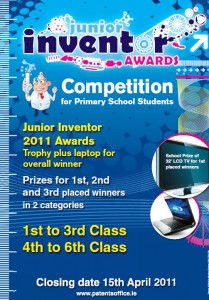
The Patents Office have recently launched the Junior Inventor Awards 2011. The Awards, which is now in its 4th year, seeks to encourage primary school children to demonstrate their creativity and inventiveness, and hopefully sow the seeds of interest in the sciences and engineering at an early age. Entries can include any idea for an invention that solves an everyday problem, for example the GPS system in cars or the dishwasher – ideas that makes life better or easier. Pupils are required to provide a drawing or illustration of their invention together with a short written description of the invention. The competition was originally launched by the Patents Office to mark its contribution to World Intellectual Property Day, which falls on the 26th April every year.
This year’s competition is divided into two class categories with one overall winner who will be presented with the Junior Inventor Award 2011. The categories are: –
o First Class to Third Class
o Fourth Class to Sixth Class
Prizes will be awarded in each category and the first placed winners in each category will also receive a prize for their schools. Launching the competition, Eamonn Laird, Controller of Patents, Designs and Trademarks, said: ‘The Junior Inventor Awards has proved very popular with Primary School teachers and pupils and has gone from strength to strength since its inception. The level of creativity and inventiveness of the children never ceases to amaze me and that is certainly encouraging for the future of innovation in Ireland. I would urge all Primary School teachers to enter their pupils in this exciting and challenging competition.’ The closing date for entries is Friday 15th April 2011 at 5.00pm and the address to send entries is: Junior Inventor 2011, Patents Office, Government Buildings, Hebron Road, Kilkenny. The winners will be announced at a presentation ceremony in Kilkenny on Monday 16th May 2011. All Primary Schools should have received notification of the competition in the post and details are also available on the Patents Office website. Competition Rules are also available for download.
Educating to End Animal Cruelty
My name is Gillian Bird and I have been with the Dublin SPCA since 1998. I set up and have been running the Society’s Education Department since 2000 and during that time I have give thousands of talks to people of all ages throughout Dublin and the Republic of Ireland. The Dublin SPCA education service teaches people about the importance of caring for animals in general, especially pets, through talks in schools, workshops and tours of the animal centre in Rathfarnham. Over the past 11 years, the education services has become a very popular choice with teachers and youth leaders and as a result each year see an increase in the number of talks and tours given. read more…
Cómhabhair don Pancóga
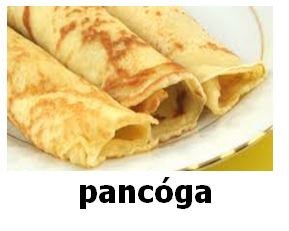
Pictiúir agus foclóir do na comhábhair le haghaidh pancóga ar Máirt na hInide.
Foinse: GAA Obsessed
(comhad .doc 368KB)
Ag Déanamh Pancóga

Dán simplí faoi ag déanamh pancóga ar Máirt na hInide.
Foinse: GAA Obsessed
(comhad .doc 23KB)
Tráth na gCeist 2011
Ocht babhta le sé cheist i ngach babhta, babhta réitigh chomh maith le freagraí go léir ar 127 sleamhnán Powerpoint. Tá an tráth na gceist seo an-oiriúnach don CBI (IWB) sa seomra ranga nó i halla na scoile. (comhad .ppt 1.0MB) Íoslódáil an Comhad…
St. Patrick’s Day Bookmark 02
Seasonal printable bookmarks with the caption, “Lá Fhéile Pádraig”. Bookmarks are a good incentive for reading for pleasure. (.pdf file 7.93KB) Download File…
Pancake Recipe
Posters showing the main ingredients for making pancakes on Shrove Tuesday. (.pdf file 926KB) Download File…
Trócaire Lenten Resources 2011

The Irish charity, Trócaire, is the official overseas development agency of the Irish Catholic church. It was set up by the Irish Catholic Bishops in 1973 to express the concern of the Irish Church for the suffering of the world’s poorest and most oppressed people. Trócaire works through global Catholic networks and with local partners on the ground. When they help people, they work with them, so that they drive the entire process themselves. Solutions are not imposed on the people they help. Instead, they become the authors of their own destiny.
For some years, Trócaire has been producing excellent resource material for the classroom. It is usually based around their work in a developing country and it is usually tied in with the season of Lent and their Lenten fund-raising campaign through the Trócaire fast boxes. The focus of the resources this year is the country of Honduras and five year old Digna tells the story of her life. Trócaire has made a huge amount of resource material available on their website. Resources include:
-
Photo packs for both junior and senior pupils
-
Posters
-
Teacher resources
-
Worksheets on poverty, climate change, fair trade and equality
Download the Trócaire Lenten Resources 2011 now. Trócaire also have lots of other School Resources to download.
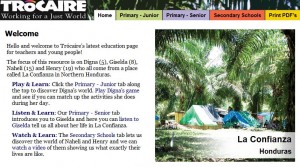
This year Trócaire has also developed resources for the Interactive White Board (IWB), again based on the theme of Honduras. There are separate sections for junior and senior primary pupils. The junior section focuses on the life of five-year old Digna and the senior section focuses on the life of eight-year old Giselda. Pupils can learn about life in Honduras, about the communities these children live in and play some games. The IWB exercises can also be downloaded as .pdfs. You can access these Trócaire IWB Resources online now.