


Welcome to Seomra Ranga, the Hub for Primary School Resources. For the overseas visitors “Seomra Ranga” means “classroom” in the Irish language.
Seomra Ranga has been successfully providing tried and tested resources for primary school classrooms since 2007. Since that time, the site has gradually built up a strong following amongst educators as a repository of quality teacher-created resources. The resources on the site, which support all areas of the curriculum, are arranged in accordance with the curricular provisions of the Irish primary school….

Materials Matching
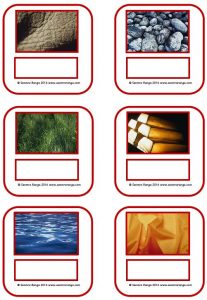 This resource is aimed at pupils in junior/middle classes or SEN pupils with speech and language difficulties. It assumes an ability to read. The materials vocabulary would also need to be taught in advance. Its aim is to assess whether pupils can match the materials-related words with the appropriate images. It links with SESE Science.
Laminate all of the pages in the resource. Cut up the images into 12 separate cards. Cut up the materials words on page 3.
Alphabetical Order Ladder 05
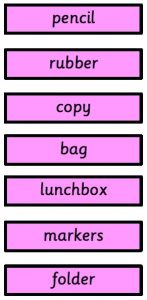 This resource is aimed at giving pupils practice of ordering words by alphabetical order. The vocabulary used are in groups eg. colours, numbers, rooms in the house etc. There are six different sets of words to place in order, with seven words in each set.
Laminate all pages in the resource. Leave page 1 intact and cut up the words on pages 2-7 into cards. Place velcro on the rear of each card as well as in the seven spaces on the ladder. Pupils must then place the words in alphabetical order on the ladder
Materials Bingo
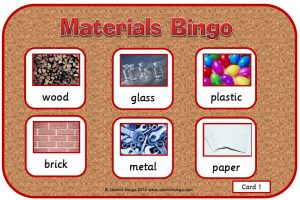 Educational bingo games are a great way for pupils to learn so many different skills. They help with listening skills, visual discrimination, group work, turn taking and the reinforcement of the learning content of that particular bingo game.
This bingo game focuses on the theme of “Materials” in SESE Science and it features images like glass, metal, stone, leather, material etc. It is aimed at a group of six pupils, so it would be useful for Station Teaching
Ordinal Number Arrows 02
 Ordinal Numbers are numbers that tell the position of items in a list eg. 1st, 2nd, 3rd etc. The ordinal number flashcards in this resource are portrait and three to a page. Included are flashcards from 1st to 12th as well as a header which says “Ordinal Numbers”.
The flashcards could simply be laminated and used as a display or they could be used to get pupils to place beside a set of items on the table or on the floor. I’m sure there are lots of other creative ways they could be used in the classroom.
300 Square Patterns
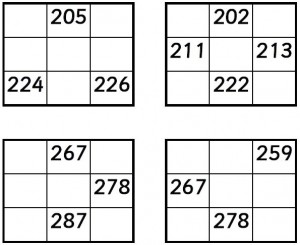 This worksheet for pupils features sections of a maths square cut out where the missing numbers have to be filled in. The worksheets focus on numbers 200 – 300. There are six different puzzles to solve on each page. The pupils have to use their knowledge of maths squares to work out the missing numbers, using strategies such as: What number comes before this? What number comes after this? What number is ten more/less than this number? etc.
Ordinal Number Arrows 01
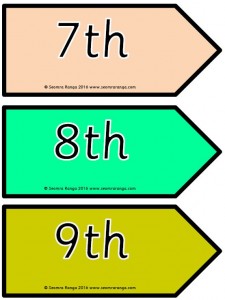 Ordinal Numbers are numbers that tell the position of items in a list eg. 1st, 2nd, 3rd etc. The ordinal number flashcards in this resource are landscape and three to a page. Included are flashcards from 1st to 12th as well as a header which says “Ordinal Numbers”.
The flashcards could simply be laminated and used as a display or they could be used to get pupils to place beside a set of items on the table or on the floor. I’m sure there are lots of other creative ways they could be used in the classroom.
Daoine Ag Obair
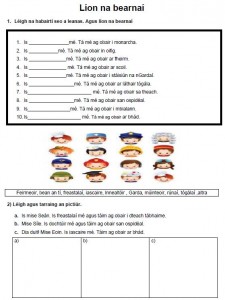 Bileog oibre atá i gceist san acmhainn seo, má tá tú ag múineadh gairmeacha beatha sa seomra ranga. Tá dhá rud le déanamh ar an mbileog – “Líon na Bearnaí” agus “Léigh agus Tarraing”.
(comhad .pdf 118 KB)
200 Square Patterns
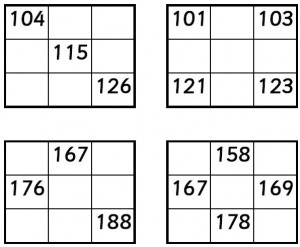 This worksheet for pupils features sections of a maths square cut out where the missing numbers have to be filled in. The worksheets focus on numbers 100 – 200. There are six different puzzles to solve on each page. The pupils have to use their knowledge of maths squares to work out the missing numbers, using strategies such as: What number comes before this? What number comes after this? What number is ten more/less than this number? etc.