
Póstaer Foghraíochta – oi
Póstaer foghraíochta le liosta focal leis an patrún “oi”. (comhad .pdf 59.7KB) Íoslódáil an Comhad…
Interview with Minister Ruairí Quinn – Call for Questions
Seomra Ranga is delighted to announce that, to mark the beginning of the new academic year, the Minister for Education and Skills Ruairí Quinn TD has agreed to take part in our interview series on the site. For those not familiar with the format of the interview series, this is how visitors to the website can…
Switch Off!
This sign for the classroom or for the school building in general is designed to encourage pupils to conserve electricity by turning off lights. It uses the simple motto: “Switch Off!”. It can also be used for the energy flag in the Green Schools Programme. (.pdf file 290KB) Download File…
LOLO
This sign for the classroom or for the school building in general is designed to encourage pupils to conserve electricity by turning off lights. It uses the motto: “LOLO – Last Out, Lights Off”. It can also be used for the energy flag in the Green Schools Programme. (.pdf file 105KB) Download File…
Word Reversals 03
This is an oral language activity that can be done with pupils in middle and senior class standards. On each card are the names of four everyday objects, which may have a loose connection. The purpose of the activity is to help develop the working memory of the pupils, while at the same time encouraging…
Trails.ie
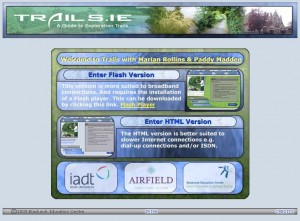
Trails.ie is a website full of resources for teachers who wish to use the local environment to develop a trail for pupils to explore. The website itself explains that, “A trail is an organised or structured walk for the purpose of observing and exploring different aspects of the built and natural environment. It focuses on specific points of interest so that a field study is engaging and beneficial to pupils and teachers”. A trail is activity based and can be relevant to any area of education. Topics may include Environmental Studies, History, Geography, Science, Mathematics, Technology and the Arts.
The site details the main aims and skills that are developed by using a trail as an educational methodology. It shows how to compile a trail, how to choose a route and things to take note of. It shows how to vary the different types of questions used in the trail as well as safety issues that need to be taken into consideration. However, the great thing about the site is that it provides the teacher with lots of resources to put a trail together. It provides graphics on stops, senses, activities and directions to be used when putting the document together. There are samples and templates of trails to view and there is also a trail builder which the teacher can use to put their own trail together. Videos are also used throughout the site to demonstrate different aspects of the trails process. All in all, this site is well worth a visit if you are putting together a trail in your local environment.
(There is an Irish version of this site www.rianta.ie but it does not appear to be working at the moment.)
Literacy and Numeracy for Learning and Life
On July 8th, the Minister for Education and Skills, Ruairí Quinn TD, launched “Literacy and Numeracy for Learning and Life – The National Strategy to Improve Literacy and Numeracy among Children and Young People 2011-2020“, a wide ranging new strategy aimed at ensuring that every child leaves school having mastered literacy and numeracy. This National Strategy to improve literacy and numeracy among children and young people is seen as a key pillar of the Programme for Government for the new Fine Gael / Labour coalition. Speaking at the launch, Minister Quinn said, “It is the government’s belief that no child should leave school unable to read and write and use mathematics to solve problems. We know that there is currently much room for improvement and this strategy sets out the road map with concrete targets and reforms that will ensure our children, from early childhood to the end of second level, master these key skills.”
The Strategy aims to ensure that teachers and schools maintain a strong focus on literacy and numeracy skills, within a broad and balanced curriculum. It sets out a wide-ranging programme of reforms in initial teacher education courses, in professional development for teachers and school principals, and in the content of the curriculum at primary and post-primary levels in order to achieve these vital skills. Schools will be required to make greater use of standardised tests of reading and mathematics in second and sixth class in primary schools and introduce these tests for 2nd year students in post-primary schools. They will be required to report the findings to parents, Boards of Management (BOM) and the Department of Education and Skills (DES). Schools will be required to develop and implement school improvement plans in accordance with guidance from the Department’s Inspectorate. A circular will be issued to primary schools shortly, requiring them to increase the time available for literacy to 90 minutes per day and for mathematics to 50 minutes per day (up from 36 minutes currently) from this September.
Given the financial constraints facing the country, Minister Quinn said that the Strategy had been developed in a way that keeps additional costs to a minimum. “This means that we will have to find the necessary resources for literacy and numeracy by re-prioritising existing spending, by cutting activities that may be desirable but less important, and by ensuring that we get the very best outcomes from whatever financial and human resources we have,” stated the Minister. The Minister concluded that he wanted a “concerted national effort to achieve world-class literacy and numeracy skills among our children and young people.”
Sheila Nunan, General Secretary of the Irish National Teachers’ Organisation (INTO), said the union would consider the plan carefully, discuss it with teachers, see what bits of it were worthwhile and what parts could be implemented. However, her initial reaction to the strategy could only be said to be “lukewarm”. She remarked that this plan was being introduced at a time when many teaching jobs were being lost. “You cannot on the one hand demand higher standards and then cut teacher numbers, reduce funding, decrease supports for special needs and disadvantaged children and increase class size”, Ms Nunan said. She said that these cutbacks would compromise the ability of schools to deliver on the plan. “The government’s commitment to literacy and numeracy will be seen in the next budget. If teacher numbers are cut then this plan is not worth the paper it is written on,” said Ms Nunan. “The challenge for the Minister is to ring fence front line staffing and find the resources to support a rise in standards. If he doesn’t do this, then this plan will be a pointless exercise.”
This sentiment was broadly backed by Pat King, General Secretary of the Association of Secondary Teachers of Ireland (ASTI). Commenting on the launch of the plan by Minister Quinn, Mr. King said, “Literacy skills have a significant influence on a young person’s future life chances. The ASTI welcomes this focus on literacy. However, it is important to point out that quality learning requires a quality learning environment. The learning environment of schools is significantly affected by resources such as the number of teaching staff, access to specialist staff and the availability of educational resources including new technologies and reliable broadband connection. In this context, we are appealing to the Government not to impose further cuts on our under-resourced schools. Further cuts will militate against the effective delivery of the Minister’s literacy plan and on the delivery of a range of other plans, programmes, and projects which are currently being implemented in schools.”
The 88 page Literacy and Numeracy Strategy can be downloaded from the DES website HERE.
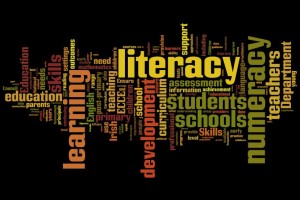
View the Wordle of the text of the Literacy and Numeracy Strategy HERE.
Rounding to the Nearest 100 (Larger Numbers)
Powerpoint presentation on how to round numbers that are between 1000 and 10,000 to the nearest 100. It gives rules about how to round numbers, shows examples and gives exercises for pupils to complete. These strategies are essential for mastering the skill of estimation. (.ppt 1.16MB) Download File…
Word Reversals 02
This is an oral language activity that can be done with pupils from first/second class upwards. On each card are the names of three everyday objects, which may have a loose connection. The purpose of the activity is to help develop the working memory of the pupils, while at the same time encouraging them to…
Word Reversals 01
This is an oral language activity that can be done with pupils from first/second class upwards. On each card are the names of three everyday objects, which may have a loose connection. The purpose of the activity is to help develop the working memory of the pupils, while at the same time encouraging them to…