


Welcome to Seomra Ranga, the Hub for Primary School Resources. For the overseas visitors “Seomra Ranga” means “classroom” in the Irish language.
Seomra Ranga has been successfully providing tried and tested resources for primary school classrooms since 2007. Since that time, the site has gradually built up a strong following amongst educators as a repository of quality teacher-created resources. The resources on the site, which support all areas of the curriculum, are arranged in accordance with the curricular provisions of the Irish primary school….
Brown Bear Patterns – Pack 2
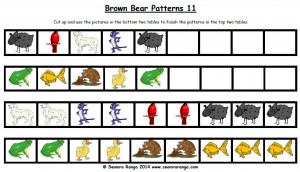 Making pupils aware of patterns is a key objective in the early maths curriculum. This resource is based on the picture book “Brown Bear, Brown Bear, What Do You See?” and features animals mentioned in the story. It is suitable for pupils in junior classes as well as SEN pupils. Pupils are required to cut up the pictures from the bottom two tables and use them to complete the animal patterns in the top two tables on the page.
Brown Bear Odd One Out Pack 2
 This resource is geared towards pupils in junior classes and SEN pupils to assist with visual discrimination and oral language skills. It is based on the picture book “Brown Bear, Brown Bear, What Do You See?” and features animals mentioned in the story. Pupils are asked to work out which picture is different in each row and say in what way it is different.
Brown Bear Picture-Ordinal Number Matching
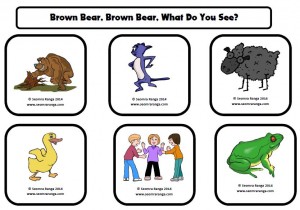 This resource is based on the picture book “Brown Bear, Brown Bear, What Do You See?” It features images of animal characters from the story on cards. Pupils are asked to firstly listen to the teacher reading the story, then cut out the images and the ordinal numbers and stick them together in the order that they appeared in the story. This work is good for visual discrimination, story sequencing as well as learning ordinal numbers in maths in maths.
Brown Bear Patterns – Pack 1
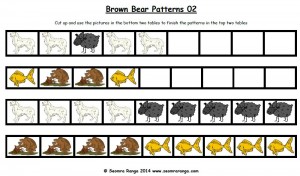 Making pupils aware of patterns is a key objective in the early maths curriculum. This resource is based on the picture book “Brown Bear, Brown Bear, What Do You See?” and features animals mentioned in the story. It is suitable for pupils in junior classes as well as SEN pupils. Pupils are required to cut up the pictures from the bottom two tables and use them to complete the animal patterns in the top two tables on the page.
Brown Bear Odd One Out – Pack 1
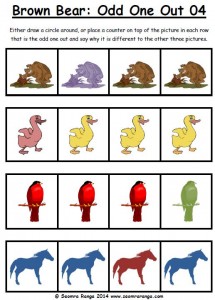 This resource is geared towards pupils in junior classes and SEN pupils to assist with visual discrimination and oral language skills. It is based on the picture book “Brown Bear, Brown Bear, What Do You See?” and features animals mentioned in the story. Pupils are asked to work out which picture is different in each row and say in what way it is different.
There are six pages in this pack with four exercises on each page. The pages could be laminated to be re-used again and again.
Plenty 20
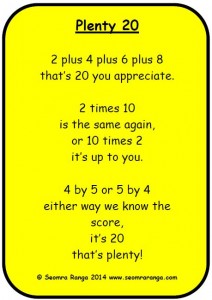 ‘Plenty 20’ is an original poem for number work in maths up to 20. It would work very well in 2nd/3rd class and could suit others too. It could also be used as an action poem , with the class holding up the appropriate number of digits as they say the different numbers.
Source: Séamus Mc Andrew
Brown Bear: How Many? – Pack 2
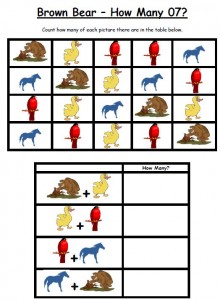 This resource is based on the picture book “Brown Bear, Brown Bear, What Do You See?” It features animal characters from the story. Pupils are presented with a grid of 20, containing sets of four different animals from the story. They have to count and record how many of each animal they find in the grid. This work is good for visual discrimination as well as number work in maths.
There are six worksheets in this pack where pupils are asked to count and record combinations of 1, 2, or 3 animals in the grid.
Brown Bear: How Many? – Pack 1
 This resource is based on the picture book “Brown Bear, Brown Bear, What Do You See?” It features animal characters from the story. Pupils are presented with a grid of 20, containing sets of four different animals from the story. They have to count and record how many of each animal they find in the grid. This work is good for visual discrimination as well as number work in maths.
There are six worksheets in this pack where pupils are asked to count and record single animals in the grid.