
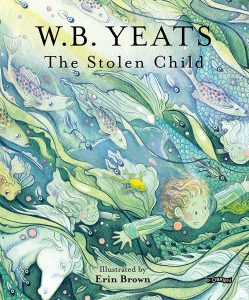
 The Stolen Child, a jewel of a poem, composed by W.B. Yeats when he was twenty-one years old, is illustrated and brought to life by Erin Brown’s vibrant artwork in this hardback book, published by O’Brien Press. W.B. Yeats’ reputation is that of a much-loved and venerated Irish poet of international acclaim, being acknowledged as a source of inspiration to singer/songwriters like Leonard Cohen and Sinéad O’Connor, among a multitude of others.
W.B. Yeats has a particular connection to Sligo, not least because he is buried in Drumcliffe Graveyard in the shadow of Ben Bulben, close to Lissadell House, where he spent many summers in the company of the Gore-Booth family. The poetry of Yeats is woven into the fabric of West of Ireland childhoods – poems such as ‘To The Squirrel at Kyle-Na-No’, ‘The Wild Swans at Coole’, ‘The Song of Wandering Aengus’, learnt off by heart and recited at local Feiseanna.
‘The Stolen Child’ is a gorgeous gem of a poem, which reflects Yeats’ interest in Irish Folklore and the supernatural. The introduction to the book explains his fascination with faeries and tales of children being stolen and replaced, the Changelings of our folklore.The introduction explains the layout of the poem as well as giving us interesting background information about Yeats.
Erin Brown’s illustrations bring this perfect gem of a poem to life in this hardback picture book. The dust cover is vibrant and verdant, but underneath this, on the actual cover of the book, is a white print on a green background, encapsulating the thinning of the veil, the conjunction of the faery and real world. Each of the four verses of the poem is richly illustrated with Erin Brown’s original artwork, where the fairies hide and emerge in the natural surroundings of County Sligo as the poem progresses to its conclusion.
Slewth Wood is the setting for Verse 1, where the fairies emerge in the midst of the lush natural beauty and the bountiful Autumnal harvest of glistening red berries and ‘stolen cherries’. I was immediately drawn into this richly-drawn wood, brim-full of local wildlife and hiding the fairies. In particular, the illustration of the fairy hand reaching to grasp the human hand on page 10 is a stunningly appropriate illustration of the just-out-of-reach merging of both worlds. One wonders if the child had grasped the fairy hand there and then how the poem would have finished?
Ben Bulben is the backdrop for my one of my favourite illustrations on pages 11 and 12. Erin has aptly captured the mingling of the human and fairy worlds at dusk in the moonlight, with the reflection of the human world showing the hidden, mystical, magical fairy realm. As the poem continues, the child emerges more fully in the illustrations, as do the fairies, possibly emboldened by the growing interest of the child and his lack of fear, maybe by their growing confidence in luring him into their fairy realm?
Erin Brown’s illustrations are richly detailed artworks that draw the reader in, allowing them to get lost in the narrative, to wonder what will happen next, to soak up the poem through the colour and appropriately mystical pictures that bring the poem to life. Verse 3 brings us to Glencar and the evocative illustration of the child swimming underwater with fish, tadpoles, vegetation and magical white horses. This verdant illustration is reproduced on the front of the dust cover for the book and rightly so as it evokes the complete mingling of both worlds.
In truth, each page of this beautiful book deserves to be lingered over, to appreciate the intricate details woven, as if by magic, into each piece of art that brings ‘The Stolen Child’ to life. This is most definitely a book to be read and enjoyed on multiple occasions, as upon each reading, new and hidden details will be uncovered. It feels as if magic, mystery and fairy dust have been interwoven with the colour on each page!
In the final verse, the child follows the fairies into their realm, leaving the human world of sadness and sorrow behind. The illustrations depict a child that has now become more fairy than human as he leaves the mundane world behind and ventures joyfully and optimistically into his new life within the fairy world.
The picture on page 27 captures the human world perfectly – the ivy-clad Georgian window framing a pastoral landscape outside, painted in muted greens, with a welcoming pot of tea and bowl of oatmeal on the inside. ‘He’ll hear no more the lowing, Of the calves on the warm hillside, Or the kettle on the hob, Sing peace into his breast’. In stark contrast to the muted, neutral tones of real life, the final two pages of the book depict the now fairy child wearing bright, jewel-coloured robes, rather like a prince or a king, riding a magnificent white stallion, leading a procession of assorted animals and fairy folk into a bright beyond.
Traditionally, children were depicted in folklore as being stolen by the fairies. But through the evocative, rich and original illustrations crafted by Erin Brown, one is left with the distinct impression that the child left by choice, to escape ‘From a world more full of weeping than he can understand’. The book and the poem conclude on a note of joy, of optimism and of a wonderful choice made by the human child.
Slewth Wood, known as Slishwood, Ben Bulben, Rosses Point, Glencar are all places which can be visited and enjoyed in County Sligo and having read this book multiple times to the children in my class, we have now compiled a Wish List of W.B.Yeats-associated places to visit, inspired by ‘The Stolen Child’ poem and this wonderfully illustrated book.
And if you are a music aficionado, and possibly of a certain vintage, I would recommend searching Spotify or asking Alexa to play Fisherman’s Blues by The Waterboys and in particular their musical version of this poem, with narration by Tomás Mac Eoin. Play and read on repeat!
By Karen Brogan, Enniscrone, Co. Sligo.
“The Stolen Child” by Erin Brown, published by O’ Brien Press, is on sale now for €19.99 (H/B).
Disclaimer: This book was provided by the publisher, O’ Brien Press, free of charge to Seomra Ranga for the purposes of this review.